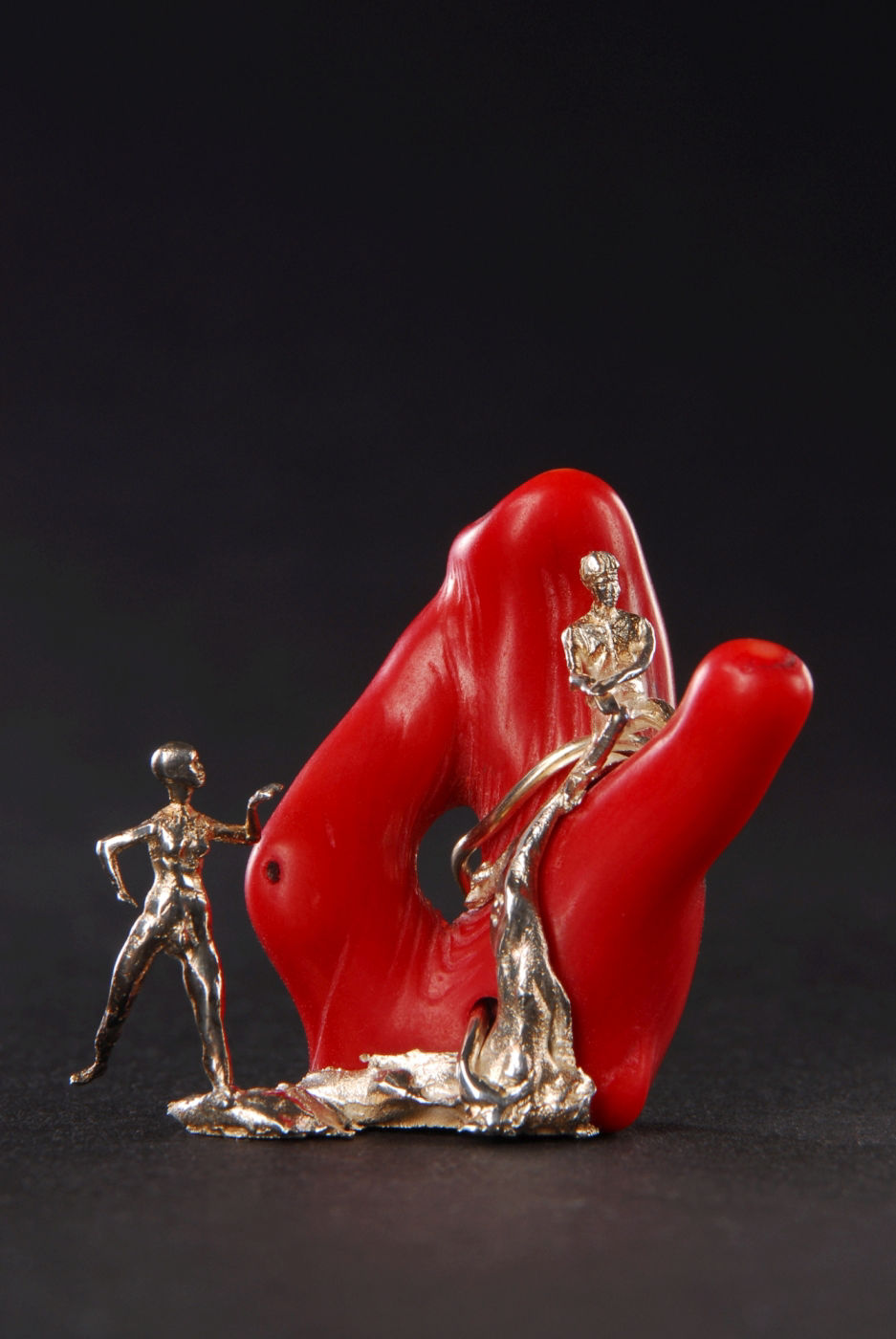
KORALLENMINNE, CORAL MINNE

Luecke_Korallenminne

925 Silber (kon.), Koralle (kon.), Maße: 41 x 29 x 36 mm, Unikat, 2007, Guss in verlorener Form

Luecke_Korallenminne

S. 20 im Katalog zur Ausstellung: Katalog-PDF
english translation below.

Ausstellung:
Metamorphosen in Miniatur: Fine Queer Art in Gold und Silber
Ausstellungsdauer: 30.04. - 22.10.2022, Residenzmuseum im Celler Schloss, 29221 Celle, Schlossplatz 1
Ausstellungsseite des Residenzmuseums: hier
Begleitprogramm: hier

english translation p. 20:
Coral Minne
925 silver (solid), coral (solid) | 41 x 29 x 36 mm | 2007, unique piece

Minnesang (Middle High German minnesanc) refers to courtly love poetry.
baroque metamorphoses
The cabinet of curiosities was a place of ambiguity, for it brought together objects from art and nature and allowed them to interact through their encounter. This created space for new connections. Combinations of materials were a popular means of breaking down categories. For example, irregular pearls, also known as ‘barocco’ (‘crooked’, ‘uneven’), were combined with precious metals. The term for the Baroque era is derived from these popular irregular pearls.
In Celle Palace, evidence of Baroque metamorphoses can be found in the stucco work on the ceilings of the Baroque state apartments.

Stucco work in the Baroque state apartments at Celle Palace

Coral in the cabinet of curiosities
Due to its nature, coral held particular significance in the cabinet of curiosities, as it is simultaneously a plant, an animal and a mineral, and thus represents an ideal, natural combination of materials in Baroque stucco work. It is therefore open to interpretation and offers great potential for the Celler Schloss Metamorphosen.
Rare red corals were popular for the creation of ‘exotica’ and ‘mirabilia’ – for example, to depict hair, as in Wenzel Jamnitzer’s ‘Daphne’, but also to represent blood. According to Ovid, coral is a marine plant that, drenched in the blood of Medusa, turned to stone (> p. 26).

Wenzel Jamnitzer, ‘Daphne’, goblet/drinking vessel, c. 1580–86
comments on the miniature

In “Korallenminne”, the coral is a tree or an architectural element. The seated figurine is not fully rendered in flowing silver down the leg; one leg “disappears” into the coral (>> New Materialism, p. 18). So is the figurine missing a leg? Or is it merging with the coral?
The standing figure has a slender upper body with muscular legs. It is connected to the flowing silver, which establishes a link with the seated (coral? -) figure. The standing figure faces the seated figure. To the minnesang?

where does metamorphosis begin?


Copyright (c) 2026 Ursula Lücke  |  Impressum  |  Datenschutzerklärung

No Code Website Builder